
Why Evolution Looks Like a Genius Is At Work
If nobody designed the polar bear, why does it look so much like they did?

A key carries real information about the lock it fits. Every bump and notch along its edge is an imprint of the shape of the lock. If you know something about the key, then you know something about the lock. Living organisms fit with their surroundings in the same way and carry information about the environment with which they interact. Everything from the polar bear’s coat, to the wing markings of a moth, to the shape of a heart valve, or the chemistry that allows a gut bacterium to live on a sugar you ate for breakfast, all fit their jobs so closely that they look as though they were specifically designed and made for those jobs.
For most of human history the obvious conclusion was that these features all had been specially constructed, that something with a plan (usually God) had shaped the living world the way a locksmith cuts a key.
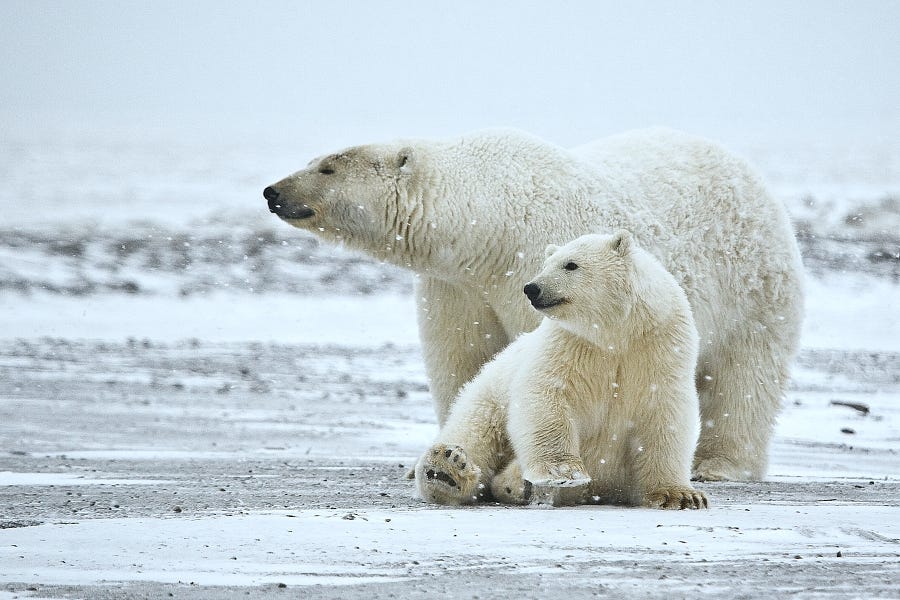
Darwin removed the locksmith and today we know that nobody has actively designed the polar bear or its coat. But still, the polar bear DOES fit its environment, so something made that happen.
Knowing that the fit between an organism and its environment is not actively created does not make the puzzle go away. If there is no designer, then why does the result look so much like design? “Natural selection did it” does little more than renaming the question. It says which process created the fingerprints. It does not say why a blind process leaves fingerprints that look exactly like the careful work of a hand.
When you learn as a child, you start with a set of guesses about how the world works, some more plausible than others. Then you get some evidence, you make some observation or hear some sound. A good learner doesn’t throw everything out and start over; they adjust. Guesses that fit the new evidence gain your confidence, guesses that don’t fit the new evidence get booted out, and over time you move in ever-decreasing circles towards the truth, or at least some best guess.
This is how a detective learns at a crime scene, and it is what a doctor does reading a test result. This kind of learning has a particular rule: given what you believed before and the evidence now in front of you, we can say precisely how confident you are allowed to be next.
Almost every population carries many slightly different versions of most of their genes. If we treat each version as a guess about how to best to make a living in this world, then some versions leave more copies in the next generation than others, the ones that fit a little better become a little more common, the ones that fit worse fade out. There is only birth and death, birth and death, birth and death.
Using a little bit of sensible inference, we could write down the rule for how common each version becomes next year. This is the same rule we might write down, from probability theory, for how a rational mind should revise its confidence after seeing evidence. The symbols in our equations would mean different things, belief and evidence in one, how common a gene is and how well it survives in the other, but the machinery underneath is identical.
Working this out properly would fill many blackboards, and biologists still argue over how far the likeness between the two goes, whether it is a deep identity or an extremely good analogy. That the resemblance is real, and that it is doing the explaining, is not in dispute.
Every death in the population is a tiny measurement. The world asks whether this version works here or not, and the answer decides which versions get to copy themselves, and which don’t. That’s it! That’s how it works.
The population gathers up the exam answers, and over many generations, information about the external world flows into the living population. The bear’s coat is information about cold and the colour of snow. The heart valve’s shape is information about the pressure of blood. Adaptation is a measure of how much a creature has in common with its world.
It is not a poetic stand-in for knowledge. It is knowledge, in the same plain sense the key holds knowledge of the lock. Design is what a large store of that shared information looks like from outside. The information is really there and life really does look engineered. It comes in modules, the same useful parts turning up repeatedly in fresh combinations, the way a competent engineer reuses a good component instead of inventing a new one each time.
On top of all this, the part of evolution that looks most like pure noise, those random copying mistakes (mutations) and the random luck of who lives and who dies (genetic drift), is not just a nuisance the process has to fight against or fight through. It’s the substance on which the product is built.
A learner who only ever sharpened their single best guess would get stuck, polishing one idea forever and ignoring any other answers. Two things need to take place at the same time if we are to find good solutions: a detection system to home in on what works, and a randomiser to wander off and stumble onto something new. Natural selection supplies the homing in capabilities, while mutation and genetic drift supplies the wandering. Engineers building search programs on computers know they must add a small dose of controlled randomness or the program locks onto the first mediocre answer and stops. Evolution has that randomness built in as a free add-on to the process of change, and the living world turns out to be arranged so that a great deal of wandering costs nothing, because many small changes make no difference to survival and let a lineage drift sideways into new territory at no charge.
The apparent foresight, the way evolution lands on answers too good to seem lucky, is a side-effect of that aimless drift. The blind walk is part of how the clever-looking answer gets found.
But remember, we only ever meet the winners. The fit between a creature and its world looks so good partly because every poorly-fitting version is gone and left nothing behind to examine. We can see today those who made it through a vast number of failed bets, and survivors always look well matched to the game, because that is what it took to survive it.
A designer builds a picture of the future, imagines what might happen, and makes choices today because of what it expects will happen later. Information flows from the imagined future into the present choice: a good definition of foresight.
Evolution has no such luxury. Every piece of information that we see in a living thing was written in the past, by the past. The genome was never asked about the future, neither was natural selection. The genome is a record of what worked, assembled entirely after the fact. A bear’s coat says “cold winters happened to my ancestors”. It does not say “cold winters are coming, so I have made arrangements”. The information runs one way only, from the world into the creature, never from a forecast into a decision.
When a creature capable of planning sees a solution perfectly matched to its problem, it naturally imagines another planner behind it. Evolution contains no planner. The world simply keeps asking the same question: does this work? Blind variation supplies the answers, and survival keeps the successful ones. Over enough generations, that alone is enough to produce something that looks uncannily like genius.
I’m writing a book on evolution along these lines, out in 2027, and posts like this are where I work the ideas out first, so subscribing means you’ll see the rest of them take shape.
I totally appreciate that you are focused on biological evolution. However, given that your audience includes others, other thinkers focused on different canvasses, you provide a springboard to consider other areas of development, human enterprise, and more specifically, its fruits.
One of which is the wheel, whose most singular and spectacular outcome is not the myriad kinds of vehicles in which it fits, but the roads on which the latter spend hours and days of productive transfer of various rubbery synthetic compounds to the road and to the atmosphere.
Choosing the wheel, and becoming dependent on it to such an extent that it is now considered an essential part of a typical road vehicle, is akin to evolution.
Still, another world is possible, right?
Evolution produces these sharp solutions because the system is always in motion. Variation pushes the lineage into new territory, selection steadies the direction, and over long stretches that combination uncovers answers that feel intentional.