
Organs
Why is everything not an integrated, undifferentiated system?

In 1995, Günter Wagner, a developmental biologist at Yale University, asked the simple question: why do organisms have parts?
Now, anatomy researchers had already figured out what most of the parts were, as well as their equivalents (what we call homologs) across different species, so this is not the question that Wagner asked. He also wasn’t asking how the parts develop - he was a developmental biologist, so he was already working on that question.
No, this new question was about why a body exists in discrete, semi-independent units in the first place. Why do you have a liver and a heart and two kidneys and a spleen as distinct organs, rather than being one continuous undifferentiated mass of tissue that does everything at once? Muscles, for example, don’t have a side-hustle as a kidney. Why does a fruit fly have a head and a thorax and an abdomen as recognisable compartments, rather than a smooth gradient from front to back? The curiosity was that at every level of biological organisation, from genetic control networks to the system of having discrete organ systems, and even to ecological communities, we find the same architecture: modules. They are discrete, they act in a semi-autonomous way, and they have strong internal connections and weak connections to each other. He called them “locally integrated units” (Wagner 1996).
Surely modularity is not inevitable. You could imagine an organism as a single integrated system in which every part depends on every other part, and nothing is separable. Some very simple organisms come close to this kind of organization. But virtually every complex organism on Earth is modular and has been for as long as complex organisms have existed. Modularity is a requirement, but a requirement for what?
About four hours after fertilization in the early embryo of Drosophila melanogaster, what has so far been a single syncytium (a bag of nuclei sharing a common cytoplasm, with no cell boundaries) begins to cellularise. Membranes form between the nuclei, and the embryo becomes a sheet of individual cells. Shortly after, the sheet folds, becomes re-organized into a multi-layered structure called the gastrula, and begins to take on the rough shape of a larva. At this point, the embryo is divided into fourteen segments, running from head to tail. Each segment is, in a sense, a developmental compartment: a group of cells that share a positional identity (assigned by the Hox system and its upstream regulators – see https://profmcinerney.substack.com/p/constraints-make-things) and that will go on to build the structures appropriate to that segment. Head segments build mouthparts and antennae, while abdominal segments build, well, abdomen.
The compartments are not just conceptual divisions, they are real physical boundaries. Cells at the border between one compartment and the next do not blend in together, neither do they cross the boundaries or wander from one compartment into another. The boundaries are maintained by cell-adhesion differences and by signalling interactions at the border, and they are completely fixed. A cell born in the anterior compartment of a segment stays in the anterior compartment, while a cell born in the posterior stays in the posterior.
This was all shown in the 1970s by Antonio García-Bellido and his colleagues (de Celis, et al. 2026). They induced genetic clones (small patches of cells carrying a visible marker) at various stages of development and asked: how far does a clone spread? The answer was that they went up to the compartment boundary, and no further. An anterior clone would never cross into the posterior compartment, no matter how vigorously it proliferated. The compartment was an independent country. Cells could do what they liked inside, they just could not have a passport to leave.
The question then became why a developing organism would impose this kind of quarantine on its own cells. The answer is damage limitation (Kitano 2004).
A developing embryo requires thousands of genes to be expressed in precise spatial and temporal patterns to produce a viable organism. As you can imagine, the potential for things to go wrong is immense. Mutations might arise within cell lineages in the developing individual, or signalling pathways might misfire. Cells can receive the wrong instructions, or if they do get the right instructions, they can get them at the wrong time. In any system this complex, errors are not the exception. The question is whether they will be contained.
This is where compartment boundaries come in. A mutation that causes aberrant growth in one compartment is confined to that compartment. It cannot spread across the boundary. The adjacent compartment continues to develop normally, oblivious to the disaster next door. The organism as a whole may be damaged, but it is not destroyed, because the damage remains local. Without compartment boundaries, a developmental error anywhere is a developmental error everywhere. A cell that starts proliferating abnormally can invade adjacent tissues, disrupt their signalling, corrupt their patterning, and trigger a cascade of failures that propagates across the entire embryo. This is, in fact, precisely what happens in certain kinds of cancer, which can be understood (with caveats) as a failure of modularity. A cancer cell might escape its compartment, ignore its boundaries, and invade tissues where it doesn’t belong and suddenly the local error becomes a systemic catastrophe.
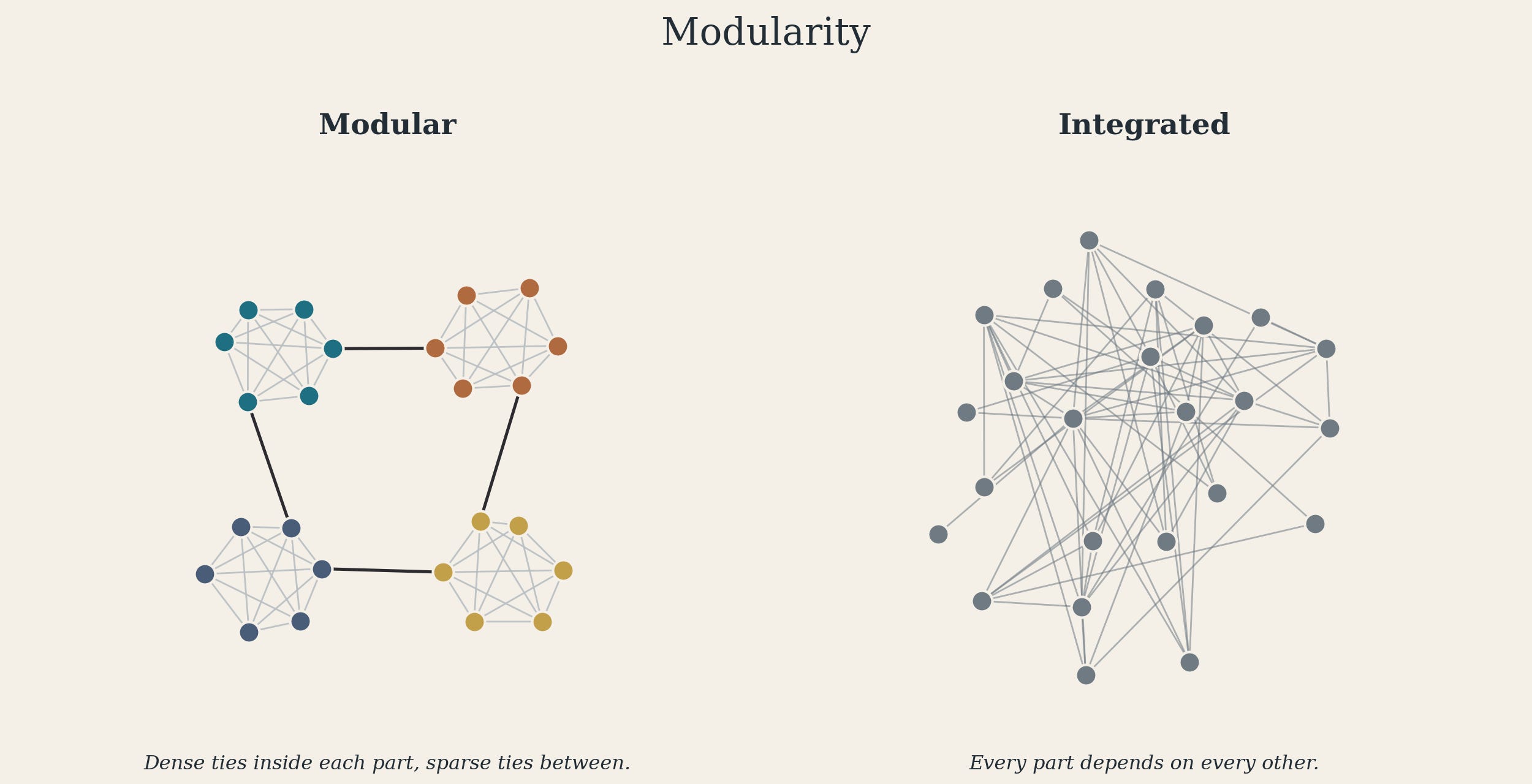
We can view modularity as an immune system for development. Modularity cannot actually prevent errors, though it prevents errors from being fatal, and we can see that principle of damage limitation, thanks to modularity, operating at every scale in biology, not just in embryonic compartments.
Gene regulatory networks, the systems of switches and dimmers and timers encoded in our DNA, are modular. The thousands of genes that must be coordinated to build an eye, or a limb, or a heart, are organised into semi-autonomous regulatory circuits (modules) that can be activated or repressed as units. The Pax6 gene, for example, sits at the top of a regulatory module that controls eye development. Switch on Pax6 in the right context and you activate an entire cascade of downstream genes that construct an eye. The module is self-contained enough that we can insert Pax6 from a mouse, into a fruit fly, and it triggers the development of a fly eye (not a mouse eye, because of course, the downstream genes are all fly genes).
You can lose a kidney and survive, and indeed, many people have done so. You can lose a limb and the rest of your body continues to function, because the limb was a semi-independent unit. Its loss is not propagated to the heart or the digestive system.
At a much larger scale, a forest is not a single integrated system in which the removal of any one species collapses the whole. It is a network of semi-independent modules (in forest ecology we talk about trophic levels, guilds, mutualisms, symbioses and so forth) that can absorb the loss of individual species without ecosystem collapse. If you eliminate a predator such as a fox, you will almost certainly see the prey populations change in abundance, but the trees don’t die. The system is resilient because it is modular. The connections between modules are real but they are loose enough that failure in one does not cascade through the entire system.
Now, modularity comes with costs, and these costs are why everything is not modular and why the principle has limits. Modularity implies redundancy, and requires maintaining separate signalling pathways, or separate organs that could, in principle, be merged into a single more efficient integrated system. Two kidneys are modular; one larger, more efficient kidney would be cheaper to make and maintain. Separate regulatory modules for eye development and limb development mean maintaining two sets of control machinery; a single integrated system would use fewer components1.
In engineering, this trade-off is well understood. A modular design is more robust but less efficient. Integrated design is usually more efficient but liable to be more fragile. A building, for example, is not wired as a single circuit but split into many, each with its own breaker, so that a fault in one room trips one switch rather than plunging the entire building into darkness. Evolution figured all this out about four billion years ago. The cost of modularity, with its redundancy and duplication of effort, is the price of not being destroyed by some simple thing that goes wrong. And in an environment where things go wrong constantly, where mutations arise every generation, where parasites evolve to exploit any weakness, where the climate changes, and where food sources vanish while asteroids occasionally smash into the planet, the price is worth paying.
The organisms that economised on modularity, whether that meant they merged their systems, or eliminated redundancy, are, almost without exception, no longer here. They might have been efficient, but they were also fragile. The modular organisms, with their wasteful duplication and their clunky semi-independent subsystems, are the ones that absorbed the shocks and kept going.
If you think about a wooden sailing vessel from the age of exploration, these ships were built with internal compartments known as bulkheads, which were watertight and divided the hull into separate sections. If the hull was breached in one section by a rock, or a cannon ball, or whatever, seawater would only flood that compartment. The bulkheads prevented the water from spreading to adjacent compartments. The ship might have lurched and listed and taken on weight, but it didn’t sink. The damage was contained. Typically, the ship could limp to port, make the necessary repairs, and sail again.
The Titanic (yes, I’m aware of the cliché, but the engineering is too good to pass up) had bulkheads, but they weren’t watertight because they didn’t extend to the top of the hull. They were walls, not sealed compartments. When the iceberg opened a gash along the side, water filled the first compartment, overflowed the top of the bulkhead into the second, which overflowed into the third, in a cascade that sank the ship in under three hours. It was a failure of modularity.
This is what cascading failure looks like. A local problem becomes a global catastrophe because the barriers between modules are insufficient, and containing failure is what real modularity, with genuine independence between compartments, is designed to prevent. And though I have been talking about cells and organs and ships, the architecture applies to lives.
Dorothy Sayers used the same image of the Titanic to make the opposite point. Writing about education, she objected to teaching in watertight compartments, each subject sealed off from the others, so that what a child learns in one never leaks into the rest. In a mind, compartmentalisation is a failure, because the value of a mind lies in the traffic between its compartments. A hull works in quite the opposite way. There, sealing off compartments is what keeps the boat afloat.
Now I want you to think about a person who has built their life as a single integrated system. Their career is their identity, and their social circle is their work colleagues. Their self-worth is found in their professional status, perhaps they are a Fellow of this, or a Member of that. Their daily routine is structured entirely around their work. Their relationship with their partner is mediated through shared professional ambitions. Even their hobbies are extensions of their career, what with the networking dinners and the annual industry conferences.
This is certainly an efficient design. Every component of that life is aligned and mutually reinforcing. There is no waste, and there is no slack. It is, in engineering terms, a hull without bulkheads. But let’s just say we suddenly remove the career, whether it is through redundancy, or a burnout so severe the person can no longer function at the level their identity requires. What happens now?
Obviously, everything will go. The social circle will collapse, because it was a professional network, not a friendship network, and they find that out as soon as they can no longer do anything for anyone. The identity will collapse, because it was welded to the job title. The self-worth will collapse, because it was indexed to professional status. Every part of this person’s daily structure vanishes, because it was the job’s structure, not the persons. The hobbies turn out not to have been hobbies at all. The breach results in total flooding, with the water pouring in over the non-existent bulkheads.
The modular alternative is less impressive on paper. It is the life in which work is important but not the sole identity. In which friendships exist outside the professional context. Friendship with people who know you as a person, not as a job title, and who will still be there when the job isn’t. In which identity is distributed across multiple domains: you are someone who works in scientific research, sure, but also someone who plays the piano (badly), who plays the guitar even worse, who mentors young people, who has a complicated relationship with ancient, constantly broken, Vespa scooters that you can’t fully explain. In which self-worth has multiple foundations, so that the collapse of any one is painful but not existential.
This life is less optimised. There are parts that don’t serve the primary professional objective. The networking-dinner people would look at it and see inefficiency, they would see time wasted on things that don’t advance the career, energy dispersed across projects that don’t compound. The networking-dinner people are building a hull without bulkheads. They will discover this when, inevitably, the iceberg arrives.
In the developing fly embryo, compartment boundaries are not passive. They are actively maintained by ongoing signalling between cells on either side of the boundary. Remove the signalling and that boundary will dissolve. Maintaining modularity is not a one-time architectural decision. It is a continuous active process that requires energy and attention. The compartment walls need to be actively held in place. If you stop investing energy in maintaining the boundaries, the boundaries will cease to exist, and the system reverts to a fragile integrated state in which a failure anywhere becomes a failure everywhere.
The friendships outside work also need to be maintained, actively, continuously, even when work is going well and the networking dinners seem more productive. The hobbies that don’t serve the career need to be protected deliberately, sometimes at the cost of professional opportunities. The parts of your identity that are not indexed to your job title need to be kept alive, even when the job is going so well that they feel redundant. Because they are not redundant, they are bulkheads, and the time to discover that your bulkheads have dissolved is not when the water is already coming in.
Günter Wagner asking the question of why organisms have parts has a simple answer. Organisms have parts because the world breaks things, and the only architecture that survives in a world that breaks things is one in which breakage is local. That is the argument for parts, and the answer has been the same for six hundred million years.
I am writing a book on evolutionary biology, and if you like the writing on this substack, then perhaps you will like the book when it comes out. Please subscribe for more.
1 (Nassim Taleb has made a related case about redundancy — nature keeps two of things because something unusual eventually happens — though redundancy is not quite modularity. Redundancy is having a spare; modularity is making sure the fire in one room can’t reach the next. You can have either without the other.)
References:
de Celis JF, Baena-Lopez LA, Baonza A, Extavour C. 2026. Antonio Garcia-Bellido: A brief history of flies, lineages, and a new developmental genetic logic. Proc Natl Acad Sci U S A 123:e2614026123.
Kitano H. 2004. Biological robustness. Nat Rev Genet 5:826-837.
Wagner GP. 1996. Homologues, Natural Kinds and the Evolution of Modularity. American Zoologist 36:36-43.
Profound information, lucidly written, easy to understand. My compliments to the author for every one of these. Man must have understood the modular nature of his build even in his primitive years, without even knowing what it means. His progress to modernity, the things he created for it, are all replete with modularity. The automobiles to IKEA furniture, almost everything in between, is modular. But nature kept safety valves in its designs, as you have elegantly described.
What a great description of modularity. I've been studying modularity for over 20 years now, and your explanation reflects a deep understanding of the concept. Indeed, how modularity is key to evolution in both technology and biology is what stimulated my interest in biological evolution in the first place.