
Good enough
What we have learned from absurd evolution

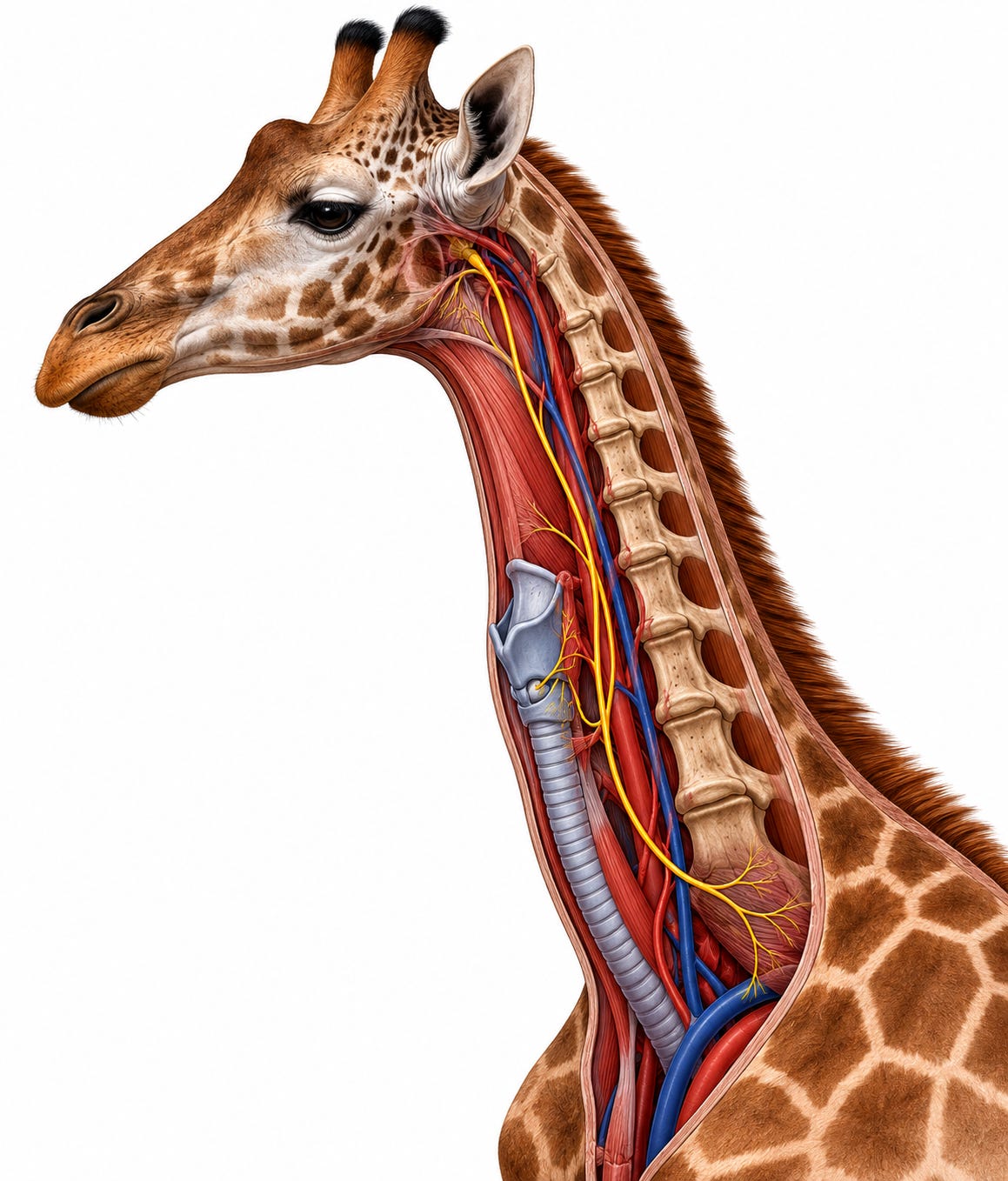
There is a nerve in your neck called the recurrent laryngeal nerve, and it connects your brain to your larynx, which is your voice box, so you can speak, swallow, and do all those things that a throat needs to do. As humans, the brain and the larynx are only a few inches apart, So naturally, you would expect the nerve to take a direct route, but it doesn’t. It travels from your skull all the way down into your chest, curves around your aortic arch (which is the main bend of the largest artery in your body), and then it climbs all the way back up to your throat. This is a 30-centimetre-long detour in order to connect two structures that really are neighbours.
This is bad enough in humans, but in a giraffe, the same nerve makes the same journey down the full length of that neck, into the chest, under the aorta, back up the full length of the neck, a full five meters of nerve to bridge a gap of centimetres.
So the natural question is, why?
To answer this question, I need to take us back about 400 million years to a time when necks didn’t even exist. If you take a look at the fish ancestors of all land vertebrates, this nerve took a perfectly sensible path. It ran behind the sixth aortic arch, which sat close to the gills, close to everything the nerve needed to reach. It was compact, it was logical, it was direct, and it was perfectly fine.
Then suddenly necks became popular. Over immense spans of time, as fish became amphibians, amphibians became reptiles, and certain reptiles became mammals, the heart descended into the chest, and the neck elongated above it. All during that time, the nerve stayed hooked around the arterial arch, because at every single step, every generation, every itty-bitty elongation, the slightly longer detour still worked. It never became a problem big enough for natural selection to act on it, because it was never broken enough to be a problem. One year became two, became 100, became a million, and 400 million years of evolution said: “That’s fine.”
The recurrent laryngeal nerve is one of us evolutionary biologists’ favourite bad design examples. The thing to understand is how evolution builds things. Evolution struggles to go back to the drawing board. It cannot redesign; it can only modify what’s already there. And if the modification works, even if it’s not brilliant or elegant, and only just good enough to not be fatal, then the modification will persist. Evolution doesn’t make a to-do list of stuff it needs to get back to fix. Evolution is a process, not an engineer. The nerve is simply what you get when a serviceable fish layout is stretched generation by generation across 400 million years of body plans that never stopped being viable at any point along the way.
When you see something like this, and you cast about for other examples, it turns out that they are absolutely everywhere.
We breathe and we swallow through the same tube. Air and food share a passage at the back of your throat, diverging only at the very bottom. The epiglottis flips shut over the trachea each time you swallow, in a piece of timing that’s absolutely essential, so that when it fails, you choke. Choking kills thousands of people every single year. It is a design flaw so fundamental that any competent engineer, that might have been given the brief: “Build an organism that needs to eat and breathe,” would unquestionably separate the two systems entirely. But the shared pharynx was there in the ancestral body plan. It was interconnected, it was functional, and you cannot redesign the ground floor while the building is occupied, and everybody in it needs to keep eating and breathing.
Well, what about your retina? Your retina is wired backwards. Yes, backwards. The photoreceptor cells, which are the ones that actually detect light, point away, not towards the incoming light, at the back of the eye. The nerve fibres and the blood vessels all run in front of them, and they all converge to exit through a single hole in the retina, producing a blind spot in each eye that your brain needs to fill in with some kind of educated guess. You are right now reading these words with equipment that is wired the wrong way around, partially blocked by its own plumbing, and missing a chunk of the visual field, that your brain is fixing as we go along. Cephalopods, which are squid and octopuses to you and me, evolved their eyes independently from ours, and they wired them the right way around. No blind spot or obstruction. If the vertebrate eye is an argument for intelligent design, it is an argument that the designer should be sacked.
And then there is your spine, a weight-bearing column that evolved in animals walking on four legs, where the load was distributed horizontally. It is, in effect, a suspension bridge. But then, for lots of reasons, our lineage decided it wanted to stand up, and suddenly the same structure had to bear a vertical compressive load, like a bridge turned on its end and asked to be a skyscraper. The result is the lower back pain that afflicts somewhere between 60 and 80 percent of all adults at some point in their lives. You may well have felt this yourself. I do. That pain in my lumbar region is not a failure of my personal fitness or my desk chair. It is 400 million years of architectural compromise expressing itself through my sacroiliac joint.
It would be easy to read all of this as a catalog of failures, with evolution as a bodger and life as a series of kludges. The truth is that every living organism is a palimpsest of historical compromises, where each layer is constrained by the layer beneath it, and none of them are removable because they are all essential.
The point I am making is that bodging works, and it doesn’t just work, it can outlast everything.
The recurrent laryngeal nerve is more than 400 million years old. The shared pharynx is even older. The backwards retina has been functioning perfectly, blind spot and all, in every vertebrate that has ever lived. That is to say, hundreds of millions of species across hundreds of millions of years have designs that, by an objective measure, are not hanging by a thread, waiting to be supplanted by something better. They have some of the most enduring structures in the history of life on Earth.
So now we ask, how can this be? How can the worst-designed systems be the most durable?
The answer, rather counterintuitively, is that they are durable because they are not optimised. An optimised design is one that has been tuned precisely as possible to its current conditions. Every component fits perfectly to its present demands. Nothing is wasted, nor is anything redundant. The system performs beautifully under exactly the conditions for which it was optimised. What happens when the conditions change?
The more precisely a system is tuned to one environment, the greater the chance that it will fail catastrophically when that environment changes. Environments change all the time, so this is not a hypothetical concern. The climate changes, competitors arrive, the pH of the environment changes, a new virus turns up, food sources disappear, your host takes an antibiotic. The one thing you can say for sure about present conditions is that they will not last.
So while the giraffe’s laryngeal nerve is insane, the same basic layout works in a fish, a frog, a lizard, a mouse, an elephant, and a whale. It works across every body plan, every neck length, every thoracic arrangement that vertebrates have ever produced. An optimised routing that always took the shortest path for the specific neck length of the specific animal, would need to be re-engineered every time the body plan changed. What looks like a stupid design today is a design that hasn’t broken when other things changed.
Which brings me to the giant panda, an animal that is exquisitely adapted to its niche, eating almost exclusively bamboo, employing a modified wrist bone to grip its stems, digesting them with a gut that is still essentially the gut of a carnivore, processing its food so inefficiently that it must eat for 14 hours a day. The panda, an epitome of specialisation, is also, in ecological terms, a dead animal walking. If bamboo were to disappear, thanks to deforestation, climate change, or disease, the panda ends up with nothing. Its optimisation is its obituary.
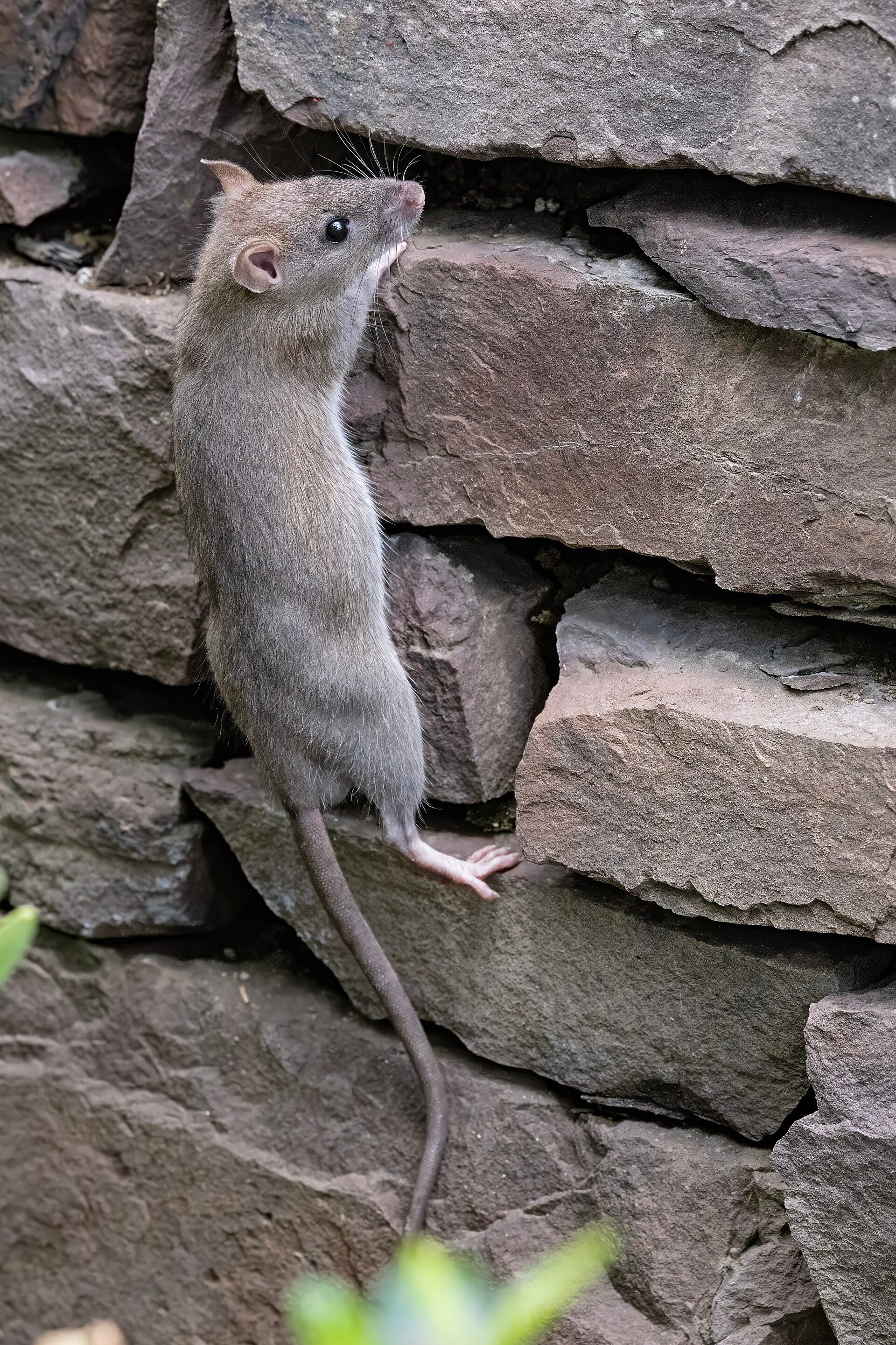
The contrast is the rat. The brown rat, Rattus norvegicus, not specialised for anything in particular, eats whatever is available, lives wherever it finds itself. It has no remarkable adaptations, no precise fit to any specific niche. It is a generalist that is mediocre at 100 different things, and not brilliant at any. The rat is everywhere and will be here long after the panda is a memory. The rat is good enough.
In 1956, the economist Herbert Simon coined the word “satisficing,” a portmanteau of “satisfy” and “suffice,” to describe how real decision-makers operate. Classical economics assumes that rational agents always optimise. They survey the available options, compute the expected value of each, and select the very best one. Simon pointed out that this is quite insane. No real agent has the time, the information, or the computational power to optimise to that degree. What real agents do is set a threshold that we might call “good enough,” and pick the first option that makes it over that threshold.
Simon won a Nobel Prize for his observation, and I’m going to suggest that he had to. The idea that “good enough” is a legitimate strategy, and not a failure to try hard enough, not a compromise, nor is it laziness, but a defensible, mathematically sound approach to operating in a complex world was alien to the intellectual culture of the 20th century. It took a Nobel prize to make this idea respectable. Ironically, biology has been employing this principle for four and a half billion years before Herbert Simon figured out a name for it. I would assert that every organism that has ever lived is a satisficer. Few, if any, have ever optimised, because optimisation requires the kind of global knowledge that no real system, biological, economic, or personal, has ever possessed.
You might raise the objection that if evolution only ever produces “good enough,” how do you explain the extraordinary precision of, say, the eye of an eagle? Or the aerodynamic perfection of a peregrine falcon in a stoop. Aren’t these examples of perfect optimisation?
No. No they are not.
Instead, they are examples of sustained local improvement. Natural selection resulting in the improvement of a particular kind of eye or a particular kind of wing, but this all takes place within the constraints that are never revisited. The eagle’s eye is superb at what it does, but it is also built on the same backward retinal plan that every other vertebrate’s eye is built on. The falcon is aerodynamically extraordinary, but it still eats and breathes through the same tube, just like you do. The eagle and the falcon are what you get when natural selection polishes and shines the outside of a structure, whose foundations cannot be changed.
Natural selection improves things in the same way that water changes a landscape. It finds the path of least resistance downhill. What natural selection cannot do is go back and start afresh. That would be the same as expecting water to run uphill (metaphorically through a period of worse function) to reach a different landscape. The good enough solution remains permanent, because the path to a better solution is blocked by the hill of non-function.
The most successful organisms on Earth have understood this (or more precisely, have been shaped by it, since understanding is not their department) for longer than complex life has existed.
I am, of course, talking about the prokaryotes. they have been around for at least 3.5 billion years, probably 4.5 billion. They have made their homes in boiling water, frozen Antarctic ice, in rocks that are two miles below the surface of the earth, inside nuclear reactors, and in our guts. Choose whatever metric you wish and these are the most successful organisms on the planet, by a country mile.
Take a look at their genomes and you see something that is close to a complete mess. Many prokaryotes carry genes that are simply no use to them right now. They maintain metabolic pathways they don’t need, they carry bits of viruses from past infections, they have mobile genetic elements in their cytoplasm and it is entirely unclear that they confer any benefit. They are shaggy, confusing, disorderly and remarkably robust. They are here today and they will still be here when we are not. The perfectly adapted panda is on life support, prokaryotes with their nonsensical genomes own the planet, and they are prepared for anything.
Tolerance of imperfection, being good enough, is the thing that lasts.
Of course, this article is not about the Giraffe’s neck, nor is it about the panda’s thumb. It is about the time you spent agonising over which route to take in life, when several routes could potentially get you there. It is about the career change you are not making because “the timing is not right”, or you haven’t built up enough savings before you make “the big move”.
I’m not telling you how to live, because I am a biologist, not a guru. The minute somebody starts telling you that you should look to the natural world for advice on how to live your life, you should head for the exit. Remember, lions rip antelopes limb-from-limb, and this is perfectly natural, so just because something is natural doesn’t mean you should go out and do it. Evolution is not wise and it shouldn’t be providing you advice for your morning skincare routine.
I can tell you what 4.5 billion years of trial and error, has produced: what lasts is not what’s best. What lasts is the thing that is most viable across the widest possible suite of conditions, for the longest period of time. “The best”, and “the most durable” are not the same, and in fact, I would say they are in tension with one another. The more finely you tune a system to current conditions, the more fragile you make it. The more you aim for the optimal, the more dependent you become on the world being unchanged. And it never will.
Good enough is not a consolation prize, nor a medal for participation. Good enough is what all the long-lived things have in common.
The rest is palaeontology.
If you have reached this part, please share this article and subscribe. I am writing an evolutionary book for publication in 2027, so if you like this kind of writing, please keep an eye out for it.
Have you read Daniel Milo's book "Good Enough" (published by Harvard Press)? He uses a similar argument to criticize hyperadaptionalist thinking.